Remove the screen and check its connector.
Maybe you can buy a controller board in china for cheap.
I took apart a EEEpc with a nice little screen.
I looked for HSD100IFW1-A00 1024-600 controller.
And ordered a
Driver Board for 10.1 “HSD100IFW1-A00/HSD100IFW1-A04 / HSD100IFW1 Lcd Composite + Tv(RF) + Usb + Vga + Hdmi-Compatibel 1024 × 600 Controller Board
It was only around 20 euro’s.


UPDATE: 20220307
I’m using Kodi for a long time now, but never was really satisfied with the results of automatically scraping metadata.
Movie names had to be just right, and changing some metadata was hard.
A while ago i made a NFO generator for own movies, digitized 8mm material, mobile movies etc.
So for movies/tv shows i started using Tinymediamanager for metadata management. You have more controll over your NFO files.
Don’t forget to add media sources to Kodi, selecting the ‘local NFO scraper’ option.
I’m using TVDB scraper in TMM, and trakt to mark seen.
But that way i’m missing IMDB top 250.
Fix:
UPDATE:
Problems with premiered date/release date showing up as movie date in kodi? Here is my fix.
find . -type f -name '*.nfo' -print -exec sed -i -e '/<premiered>/d' {} \;
Why “rubber ducking’’? While an undergraduate at Imperial College in London, Dave did a lot of work with a research assistant named Greg Pugh, one of the best developers Dave has known. For several months Greg carried around a small yellow rubber duck, which he’d place on his terminal while coding. ( From “The Pragmatic programmer” page 95)
Why rubber ducking?
A very simple but particularly useful technique for finding the cause of a problem is simply to explain it to someone else or even a object. Explain out loud (or in your mind to the duck) what each line of code is doing.
Often while doing so, you will see the problem.
Why Pair Programming?
It is no secret, i like working on a problem alone. Let me do my ‘thing’. But i like the idea of Pair Programming, why?
Changed some code controlling my wacom drawing tablet.
I use this one to draw Art, diagrams and touch up photo’s.
When using multiple screens, i had the problem it would stretch the draw area over multiple screens, streching the ratio. Or it took the work screen to work on.

#!/bin/bash
# using xinput here, check post about two mouses/keyboards on one machine
# Use xrandr to check names check
MONITOR="DP-1"
PAD_NAME='Wacom BambooFun 6x8 Pad pad'
#undo
xsetwacom --set "$PAD_NAME" Button 1 "key +ctrl +z -z -ctrl"
xsetwacom --set "$PAD_NAME" Button 2 "key e"
xsetwacom --set "$PAD_NAME" Button 3 "key h"
ID_STYLUS=`xinput | grep "Pen stylus" | cut -f 2 | cut -c 4-5`
xinput map-to-output $ID_STYLUS $MONITOR
ID_STYLUS_2=`xinput | grep "Pen eraser" | cut -f 2 | cut -c 4-5`
xinput map-to-output $ID_STYLUS_2 $MONITOR
exit 0
Most of the times i use Krita and Gimp.


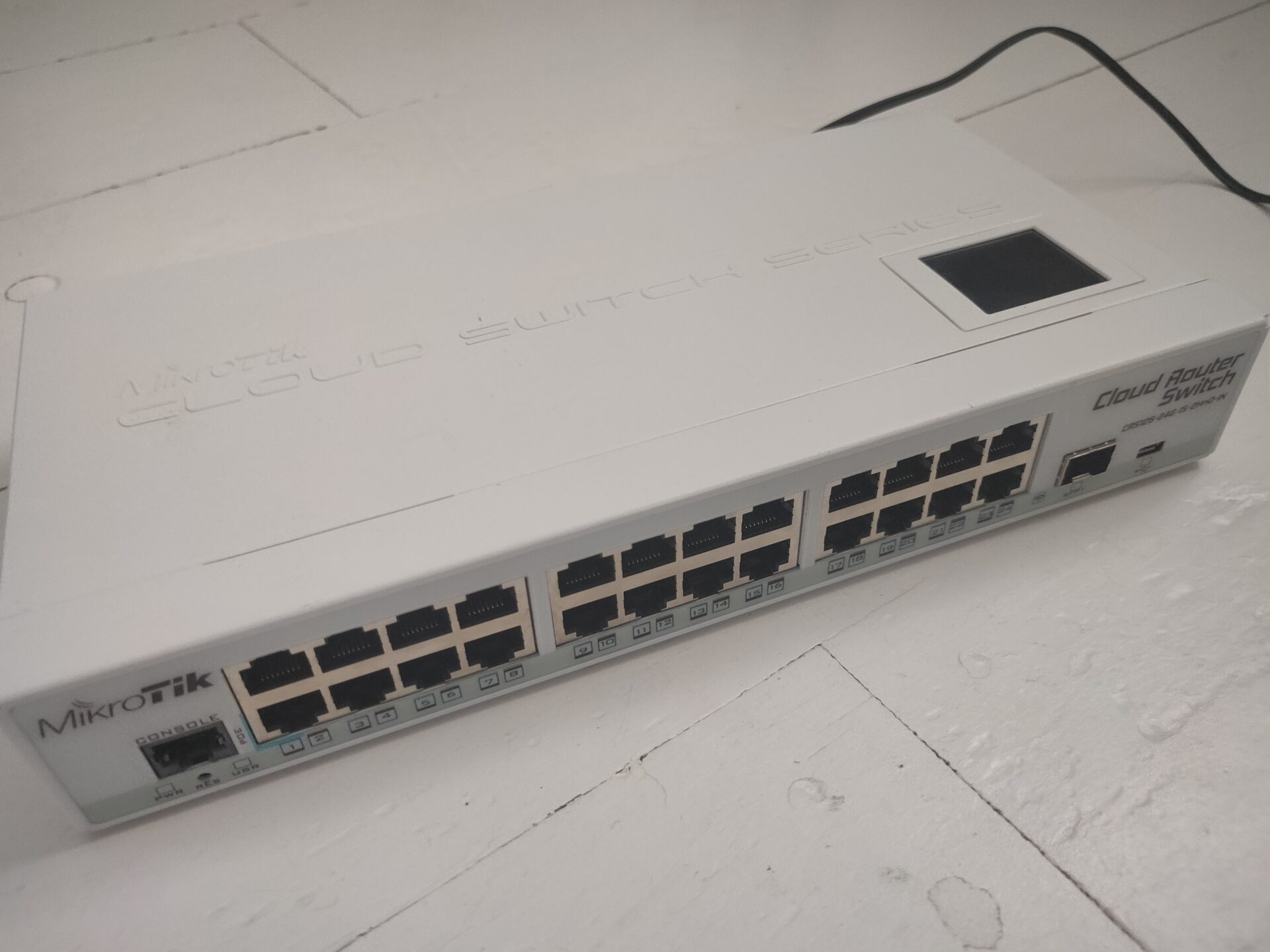
Switches and access-points
Today i got my RB4011 ! Wooot!
Total tally
To replace .. 4 SLM2008 and a TPLink switch 🙂

I’ll be posting something about connecting an arduino to the serial console using a tcp server later.
Mikrotiks are all you can eat .. And there is a lot of functionality. One of the main features (besides being switches and routers)
Installing extra packages
I’ve got several AccessPoints in my network.
Using a roaming setup, clients can connect to strongest AP.
For our Folkband i’ve setup same.
With the exception of those clients only being able to connect to the Internet, and not the rest of my Network
/interface bridge
add name=bridgeguest
/interface wireless security-profiles
add authentication-types=wpa2-psk eap-methods="" management-protection=allowed mode=dynamic-keys name=guest supplicant-identity=MikroTikHAP wpa2-pre-shared-key=guestkey
/interface wireless
add disabled=no mac-address=MACADDRESS master-interface=wlan1 name=guest security-profile=guest ssid=guest station-roaming=enabled wds-default-bridge=bridge wps-mode=disabled
/ip pool
add name=guest ranges=10.5.0.2-10.5.0.250
/ip dhcp-server
add address-pool=guest disabled=no interface=bridgeguest name=dhcpserverguest
/interface bridge port
add bridge=bridgenb interface=guest
/ip address
add address=10.1.0.5/24 comment=defconf interface=ether2 network=10.1.0.0
add address=10.5.0.1/24 interface=bridgeguest network=10.5.0.0
/ip dhcp-client
/ip dhcp-server network
add address=10.5.0.0/24 dns-server=1.1.1.1 gateway=10.5.0.1
/ip dns static
add address=10.1.0.5 name=router.lan type=A
/ip firewall filter
add action=drop chain=input dst-address=10.1.0.5 dst-port=22,80,443,8291,21,23 protocol=tcp src-address=10.5.0.1-10.5.0.254
add action=drop chain=input dst-address=MYNETWORKSHERE/16 src-address=10.5.0.2-10.5.0.250
add action=drop chain=forward dst-address=MYNETWORKSHERE/16 src-address=10.5.0.2-10.5.0.250
/ip firewall nat
add action=masquerade chain=srcnat comment="defconf: masquerade" ipsec-policy=out,none out-interface-list=WAN
add action=accept chain=srcnat src-address=10.5.0.0/24
I wanted to control the input of my monitors, these are my findings.
DDC – Display Data Channel
I2C – (Inter-Integrated Circuit, eye-squared-C), alternatively known as IIC, is a synchronous, multi-master/multi-slave (controller/target) bus
Getting monitor information with the ddccontrol -p command
##### PART OF THE OUTPUT ##### Detected monitors : - Device: dev:/dev/i2c-9 DDC/CI supported: Yes Monitor Name: VESA standard monitor Input type: Digital (Automatically selected) - Device: dev:/dev/i2c-7 DDC/CI supported: Yes Monitor Name: VESA standard monitor Input type: Digital - Device: dev:/dev/i2c-6 DDC/CI supported: Yes Monitor Name: VESA standard monitor Input type: Digital Reading EDID and initializing DDC/CI at bus dev:/dev/i2c-9... I/O warning : failed to load external entity "/usr/share/ddccontrol-db/monitor/AOC2490.xml"
Switching inputs
ddcutil -b 7 setvcp 0x60 0x11 # 7 is Second monitor (starts with 6), 0x60 is the input register (see below) and 0x11 is HDMI ddcutil -b 6 setvcp 0x60 0x0f # First monitor DP (Displaylink) alternative command ddccontrol -r 0x60 -w 15 dev:/dev/i2c-7
List the control registers
ddccontrol -d dev:/dev/i2c-6 ddccontrol version 0.6.0 Copyright 2004-2005 Oleg I. Vdovikin (oleg@cs.msu.su) Copyright 2004-2006 Nicolas Boichat (nicolas@boichat.ch) This program comes with ABSOLUTELY NO WARRANTY. You may redistribute copies of this program under the terms of the GNU General Public License. Reading EDID and initializing DDC/CI at bus dev:/dev/i2c-6... I/O warning : failed to load external entity "/usr/share/ddccontrol-db/monitor/AOC2490.xml" Document not parsed successfully. EDID readings: Plug and Play ID: AOC2490 [VESA standard monitor] Input type: Analog =============================== WARNING =============================== There is no support for your monitor in the database, but ddccontrol is using a basic generic profile. Many controls will not be supported, and some controls may not work as expected. Please update ddccontrol-db, or, if you are already using the latest version, please send the output of the following command to ddccontrol-users@lists.sourceforge.net: LANG= LC_ALL= ddccontrol -p -c -d Thank you. =============================== WARNING =============================== Controls (valid/current/max) [Description - Value name]: Control 0x02: +/1/2 C [New Control Value - No changes] Control 0x04: +/0/1 C [Restore Factory Defaults] Control 0x05: +/0/1 C [Restore Brightness and Contrast] Control 0x08: +/0/1 C [Restore Factory Default Color] Control 0x10: +/90/100 C [Brightness] Control 0x12: +/50/100 C [Contrast] Control 0x14: +/5/13 C [???] Control 0x16: +/50/100 C [Red maximum level] Control 0x18: +/50/100 C [Green maximum level] Control 0x1a: +/50/100 C [Blue maximum level] Control 0x60: +/772/4 C [Input Source Select (Main)] Control 0x62: +/17/100 C [Audio Speaker Volume Adjust] Control 0x6c: +/50/100 C [Red minimum level] Control 0x6e: +/50/100 C [Green minimum level] Control 0x70: +/50/100 C [Blue minimum level] Control 0xac: +/6750/65535 [???] Control 0xae: +/6000/65535 [???] Control 0xb2: +/1/8 [???] Control 0xb6: +/3/8 C [???] Control 0xc8: +/5/65302 C [???] Control 0xc9: +/8/65535 C [???] Control 0xcc: +/4/255 [???] Control 0xd6: +/1/4 C [DPMS Control - On] Control 0xdf: +/513/65535 C [???] Control 0xfe: +/4/255 [???]
Setting volume (reg 0x62) of monitor 2
ddcutil -b 7 setvcp 0x62 0x01
AOC monitor PROBLEM
You can’t switch from an input which is not active!
So my workstation is connected via DP, and i can switch to HDMI.
Now i HAVE TO use the hdmi to switch back to DP.
A solution could be to ssh into the machine connected with HDMI (passwordless login) and switch back to DP.
I made a mqtt button sending a topic that was read by the two machines using the mqtt python program elsewhere on this site.
(Rotary Mqtt Volume control)
gddccontrol
Update 20221208 – removed internals

I’ve modded several LSC devices, most of them i could flash with esp-easy or tasmota.
Why mod it? Because it uses the cloud .. i’d like to keep control myself.
Just connect/solder a USB to TTL Converter UART Module like below.
(See other posts)

But this alarm was different, i ended up removing the chip and replace it with a ESP12.

So now i had to figure out which GPIO pins and how to control them.
#1/bin/bash
# Flashed ESP Easy on this one
# When i did this, 2019, you needed version 2.1-beta1
# GPIO 4 controls LED
sleep 10
curl http://10.1.1.251/control?cmd=GPIO,4,1
sleep 1
curl http://10.1.1.251/control?cmd=GPIO,4,0
sleep 1
curl http://10.1.1.251/control?cmd=GPIO,4,1
sleep 2
curl http://10.1.1.251/control?cmd=GPIO,4,0
sleep 5
# Sending rtttl ringtone
curl "http://10.1.1.251/control?cmd=rtttl,5:d=4,o=5,b=112:8a,8a,a,8a,8a,a,8a,8c6,8f.,16g,2a,8a-,8a-,8a-.,16a-,8a-,8a,8a.,16a,8a,8g,8g,8a,g,c6"
alarm sound
curl "http://10.1.1.251/control?cmd=rtttl,5:d=4,o=5,b=160:2g,2c6,2g,2c6,2g,2c6,2g,2c6"
pager
curl "http://10.1.1.251/control?cmd=rtttl,5:d=4,o=5,b=160:8d6,16p,2d6,16p,8d6,16p,2d6,16p,8d6,16p,2d6"
Update 20221208 – removed internals
Removed my old hack and replaced it with a Wemos D1.
Added a LED
Next to do .. add a amplifier using a LM356/358
Using Python, Raspberry, a lidar module, a servo, display .. and a 3Dprinted holder.
Proof of concept was to see if it was easy to implement a lidar radar for boat navigation.
#!/usr/bin/env python
import math
import random
import pygame
from pygame.locals import *
import time
import serial
import pigpio
GPIO = 18
ser = serial.Serial("/dev/ttyUSB0", 115200)
pi = pigpio.pi()
distance = 0
pygame.init()
screen = pygame.display.set_mode((480, 320))
while True:
screen.fill((0,0,0))
pygame.draw.circle(screen, (0,128,0), (240,320), 100,1)
pygame.draw.circle(screen, (0,128,0), (240,320), 200,1)
pygame.draw.circle(screen, (0,128,0), (240,320), 300,1)
for deze in range(10,170,5):
count = ser.in_waiting
if count > 8:
recv = ser.read(9)
ser.reset_input_buffer()
if recv[0] == 'Y' and recv[1] == 'Y': # 0x59 is 'Y'
low = int(recv[2].encode('hex'), 16)
high = int(recv[3].encode('hex'), 16)
global distance
distance = low + high * 256
res = distance
#print res
x = res * math.cos(math.radians(deze))
y = res * math.sin(math.radians(deze))
xreal = x + 240
yreal = 320 - y
pygame.draw.line(screen, (0, 255, 0), (240, 320), (xreal, yreal))
pygame.time.wait(15)
pygame.display.flip()
#print(res)
pi.set_servo_pulsewidth(GPIO, deze * 11 + 500)
time.sleep(0.2)
screen.fill((0,0,0))
pygame.draw.circle(screen, (0,128,0), (240,320), 100,1)
pygame.draw.circle(screen, (0,128,0), (240,320), 200,1)
pygame.draw.circle(screen, (0,128,0), (240,320), 300,1)
for deze in range(170,10,-5):
count = ser.in_waiting
if count > 8:
#print count
recv = ser.read(9)
ser.reset_input_buffer()
if recv[0] == 'Y' and recv[1] == 'Y': # 0x59 is 'Y'
low = int(recv[2].encode('hex'), 16)
high = int(recv[3].encode('hex'), 16)
global distance
distance = low + high * 256
res = distance
x = res * math.cos(math.radians(deze))
y = res * math.sin(math.radians(deze))
xreal = x + 240
yreal = 320 - y
pygame.draw.line(screen, (0, 255, 0), (240, 320), (xreal, yreal))
pygame.time.wait(15)
pygame.display.flip()
pi.set_servo_pulsewidth(GPIO, deze * 11 + 500)
time.sleep(0.2)
#pi.set_servo_pulsewidth(GPIO, 0)