Last Updated or created 2026-01-16
I’ve been playing with all kinds of MicroControllers, but not this one.
Something new to learn.
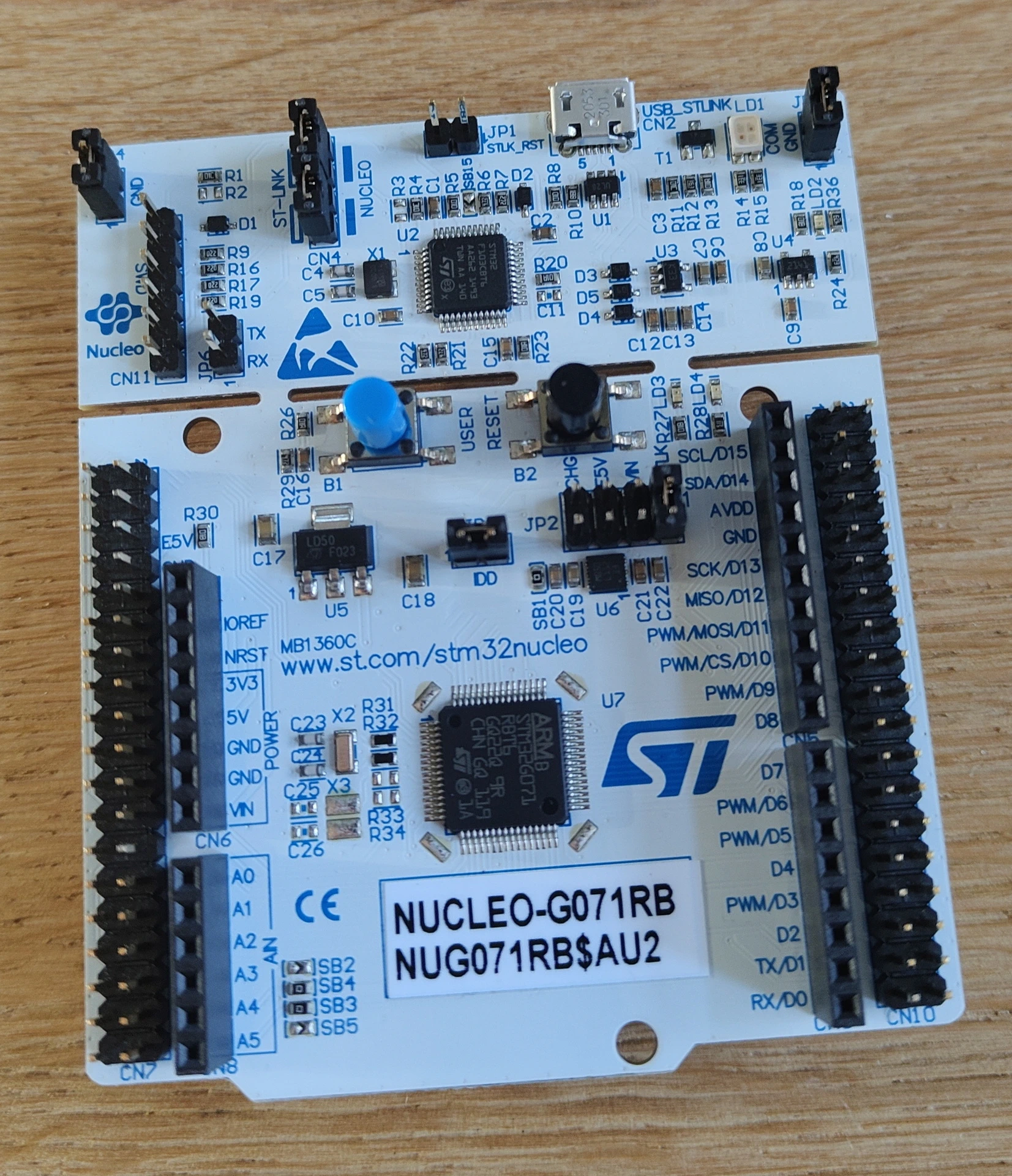
The STM32 Nucleo-64 board provides a flexible way to try out the STM32 microcontroller. The Arduino Uno V3 can be connected as a shield.
STM32 excels in high-performance, deterministic industrial control with better real-time capability, lower power, and rich peripherals, using ARM Cortex-M cores, while ESP32 dominates IoT with built-in Wi-Fi/Bluetooth, lower cost, easier Arduino/PlatformIO access, and strong community, but with higher power and less precise real-time control (Xtensa cores), making ESP32 great for connected projects and STM32 for industrial/precision tasks.
STM32 (STMicroelectronics)
Strengths:
- Performance: Superior real-time processing, deterministic behavior, efficient for complex control.
- Power: Advanced low-power modes, excellent for battery-powered devices.
- Peripherals: Rich, precise analog (ADC/DAC), extensive interface options (USB, SD, LCD).
- Reliability: Strong for industrial, medical, and automotive applications.
- Tools: STM32CubeIDE/MX, HAL/LL libraries.
Weaknesses: - Higher cost and learning curve.
- Requires external modules for Wi-Fi/Bluetooth.
ESP32 (Espressif Systems)
Strengths:
- Connectivity: Integrated Wi-Fi and Bluetooth (BLE).
- Cost & Ease: Cost-effective, easy entry with Arduino IDE/PlatformIO, great for rapid prototyping.
- Community: Strong open-source community.
- Features: Dual-core (often), built-in OTA updates, good for audio/AI.
Weaknesses: - Less deterministic/real-time performance than STM32.
- Higher active power consumption, less precise analog.
- Can have complex debugging/compilation.
- When to Choose Which
- Choose STM32 for: Industrial automation, precise instrumentation, medical devices, complex motor control, low-power wearables, general embedded systems learning.
- Choose ESP32 for: IoT devices, smart home products, Bluetooth beacons, educational projects, rapid prototyping, audio/voice applications.