Last Updated or created 2023-02-15
I wanted to control the input of my monitors, these are my findings.
DDC – Display Data Channel
I2C – (Inter-Integrated Circuit, eye-squared-C), alternatively known as IIC, is a synchronous, multi-master/multi-slave (controller/target) bus
Getting monitor information with the ddccontrol -p command
##### PART OF THE OUTPUT #####
Detected monitors :
 - Device: dev:/dev/i2c-9
   DDC/CI supported: Yes
   Monitor Name: VESA standard monitor
   Input type: Digital
  (Automatically selected)
 - Device: dev:/dev/i2c-7
   DDC/CI supported: Yes
   Monitor Name: VESA standard monitor
   Input type: Digital
 - Device: dev:/dev/i2c-6
   DDC/CI supported: Yes
   Monitor Name: VESA standard monitor
   Input type: Digital
Reading EDID and initializing DDC/CI at bus dev:/dev/i2c-9...
I/O warning : failed to load external entity "/usr/share/ddccontrol-db/monitor/AOC2490.xml"
Switching inputs
ddcutil -b 7 setvcp 0x60 0x11 # 7 is Second monitor (starts with 6), 0x60 is the input register (see below) and 0x11 is HDMI
ddcutil -b 6 setvcp 0x60 0x0f # First monitor DP (Displaylink)

alternative command

ddccontrol -r 0x60 -w 15 dev:/dev/i2c-7
List the control registers
ddccontrol -d dev:/dev/i2c-6
ddccontrol version 0.6.0
Copyright 2004-2005 Oleg I. Vdovikin (oleg@cs.msu.su)
Copyright 2004-2006 Nicolas Boichat (nicolas@boichat.ch)
This program comes with ABSOLUTELY NO WARRANTY.
You may redistribute copies of this program under the terms of the GNU General Public License.

Reading EDID and initializing DDC/CI at bus dev:/dev/i2c-6...
I/O warning : failed to load external entity "/usr/share/ddccontrol-db/monitor/AOC2490.xml"
Document not parsed successfully.

EDID readings:
	Plug and Play ID: AOC2490 [VESA standard monitor]
	Input type: Analog
=============================== WARNING ===============================
There is no support for your monitor in the database, but ddccontrol is
using a basic generic profile. Many controls will not be supported, and
some controls may not work as expected.
Please update ddccontrol-db, or, if you are already using the latest
version, please send the output of the following command to
ddccontrol-users@lists.sourceforge.net:

LANG= LC_ALL= ddccontrol -p -c -d

Thank you.
=============================== WARNING ===============================

Controls (valid/current/max) [Description - Value name]:
Control 0x02: +/1/2 C [New Control Value - No changes]
Control 0x04: +/0/1 C [Restore Factory Defaults]
Control 0x05: +/0/1 C [Restore Brightness and Contrast]
Control 0x08: +/0/1 C [Restore Factory Default Color]
Control 0x10: +/90/100 C [Brightness]
Control 0x12: +/50/100 C [Contrast]
Control 0x14: +/5/13 C [???]
Control 0x16: +/50/100 C [Red maximum level]
Control 0x18: +/50/100 C [Green maximum level]
Control 0x1a: +/50/100 C [Blue maximum level]
Control 0x60: +/772/4 C [Input Source Select (Main)]
Control 0x62: +/17/100 C [Audio Speaker Volume Adjust]
Control 0x6c: +/50/100 C [Red minimum level]
Control 0x6e: +/50/100 C [Green minimum level]
Control 0x70: +/50/100 C [Blue minimum level]
Control 0xac: +/6750/65535   [???]
Control 0xae: +/6000/65535   [???]
Control 0xb2: +/1/8   [???]
Control 0xb6: +/3/8 C [???]
Control 0xc8: +/5/65302 C [???]
Control 0xc9: +/8/65535 C [???]
Control 0xcc: +/4/255   [???]
Control 0xd6: +/1/4 C [DPMS Control - On]
Control 0xdf: +/513/65535 C [???]
Control 0xfe: +/4/255   [???]
Setting volume (reg 0x62) of monitor 2
ddcutil -b 7 setvcp 0x62 0x01
AOC monitor PROBLEM
You can’t switch from an input which is not active!
So my workstation is connected via DP, and i can switch to HDMI.
Now i HAVE TO use the hdmi to switch back to DP.
A solution could be to ssh into the machine connected with HDMI (passwordless login) and switch back to DP.
I made a mqtt button sending a topic that was read by the two machines using the mqtt python program elsewhere on this site.
(Rotary Mqtt Volume control)
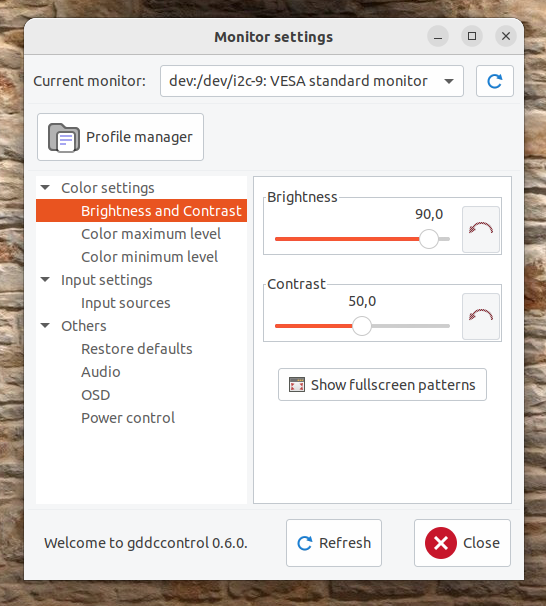
gddccontrol
Your exploration of monitor control via the DDC/CI protocol is a highly relevant example of embedded systems application within the **Electrical Engineering** discipline at Telkom University, particularly regarding the optimization of hardware communication. Your creative solution—utilizing SSH to bypass monitor firmware limitations—demonstrates keen system analysis skills in addressing technical challenges associated with modern computing devices.