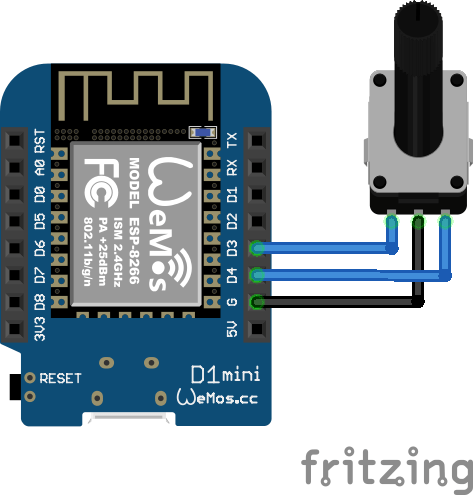
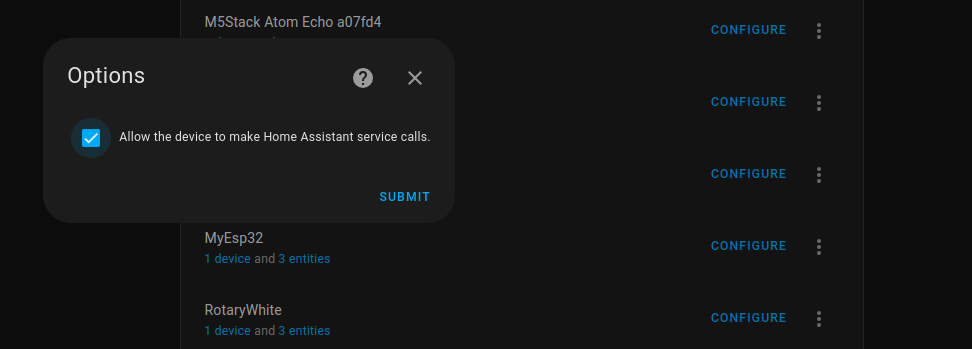
Home Assistant ESPHome with toggle for interval

Posted because I could not find a good example on the interwebs.

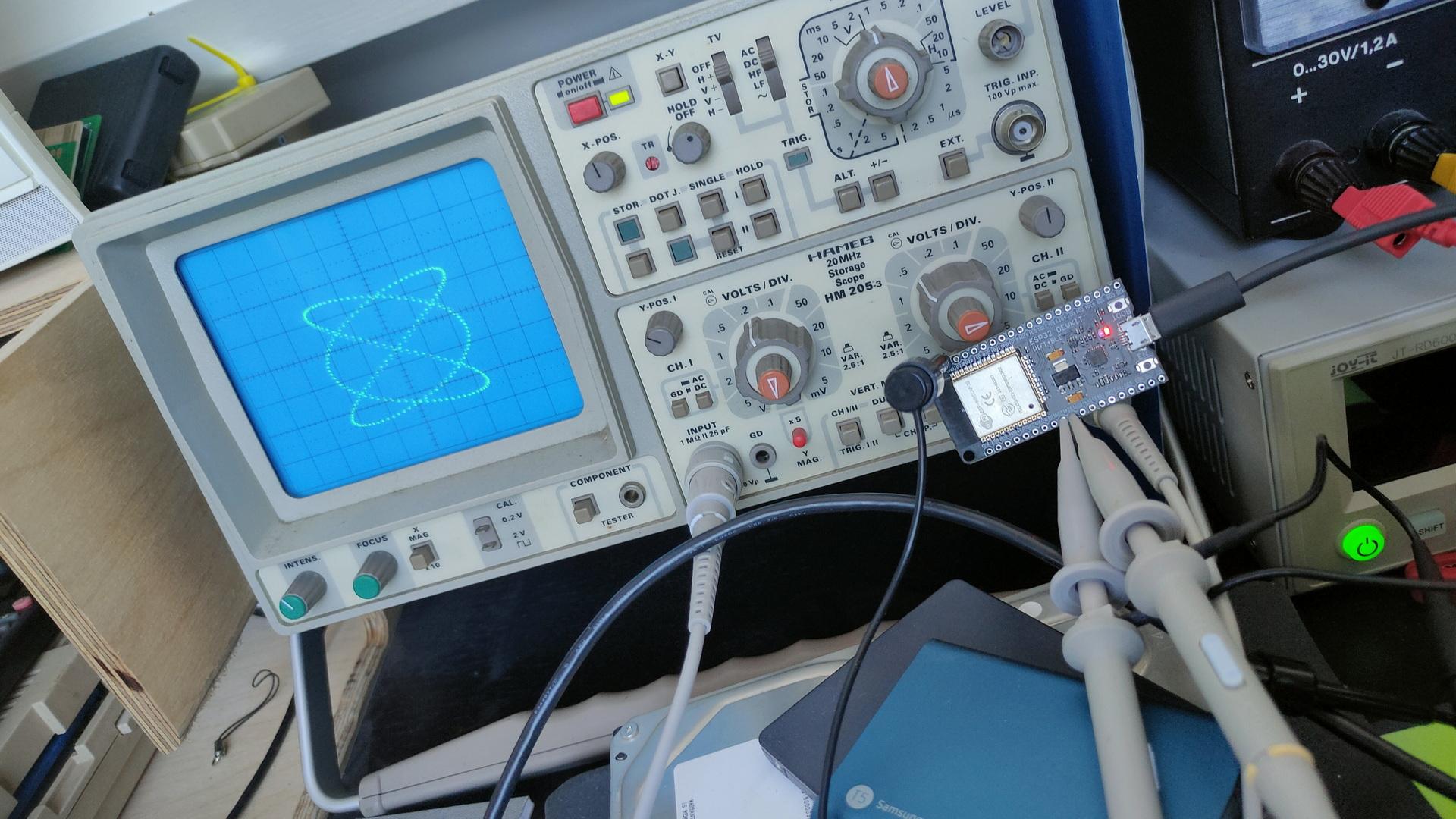
Below creates a virtual HA button which toggles a blinking led.
(button and variables are called eprint for another function, change to something meaningful. )

Home Assistant virtual mqtt switch (configuration.yml)

See switch part

mqtt:
 light:    
  - name: "KitchenOutside"
    payload_on: "99"
    payload_off: "0"
    unique_id: "KitchenOutside"
    brightness_scale: "99"
    brightness_state_topic: ha433/kitchenoutside/brightcontrol
    brightness_command_topic: ha433/kitchenoutside/brightcontrol
    state_topic: ha433/kitchenoutside/brightcontrol
    command_topic: ha433/kitchenoutside/control
    optimistic: false
    on_command_type: brightness
#-----8<-------------snip ########### EXAMPLES light and sensor
 sensor:
  - name: "LivingTemperature"
    state_topic: "home/8461/payload"
    unit_of_measurement: "°C"
    value_template: "{{ value_json.svalue1 }}"
  - name: "LivingHumidity"
    state_topic: "home/8461/payload"
    unit_of_measurement: "%"
    value_template: "{{ value_json.svalue2 }}"
#--------8<--- snip ################################ ONLY PART BELOW NEEDED 
 switch:
    unique_id: esphome_switch
    name: "Esp Home Switch"
    state_topic: "esphome/eprint/tmpstate"
    command_topic: "esphome/eprint/state"
    payload_on: "ON"
    payload_off: "OFF"
    state_on: "ON"
    state_off: "OFF"
    optimistic: false
    qos: 0
    retain: true

ESP Home config for a ESP32

esphome:
  name: lolin32litemqttled
  friendly_name: lolin32litemqttled

esp32:
  board: esp32dev
  framework:
    type: arduino

# Enable logging
logger:

# Enable Home Assistant API
api:
  encryption:
    key: "xxxxxxxxxxxxxxxxxxxxxxxxxxxxxxx="

ota:
  password: "xxxxxxxxxxxxxxxxxxxxxxxx"

wifi:
  ssid: !secret wifi_ssid
  password: !secret wifi_password

  # Enable fallback hotspot (captive portal) in case wifi connection fails
  ap:
    ssid: "Lolin32Litemqttled"
    password: "xxxxxxxxxxxxxxxxxxx"

captive_portal:
    
switch:
  - platform: gpio
    pin:
      number: 22
      mode: output
    id: blueLED
  - platform: template
    name: "eprint"
    id: eprint_enable
    optimistic: on

interval:
  - interval: 1000ms
    then:
      if:
        condition:
          switch.is_on: eprint_enable
        then:
          - switch.toggle: blueLED

mqtt:
  broker: 192.168.1.2
  on_message:
  - topic: esphome/eprint/state
    qos: 0
    payload: "OFF"
    then:
      - switch.turn_off: eprint_enable
  - topic: esphome/eprint/state
    qos: 0
    payload: "ON"
    then:
      - switch.turn_off: eprint_enable

A “new” sound chip for 6502

UPDATE: 20240225

I’ve written about General Instrument AY-3-8910 before, here is some work I did today.

This sound chip i wanted to implement in my amiga, and now it’s a alternative for my 6502 computer. ( As an alternative setup for the SID chip. )
Btw this is the same kind of chip used in the Atari ST.

A clean setup … I’ve got the sound chip and a Amplifier chip.

Above a Kicad drawing I made today, a little different from my design from the 90’s.

Below a movie clip I recorded today. Running a test setup using an Arduino nano and a sdcard reader.
The sound is bad, this is due to clipping and the absence of multiple resistors and capacitors.
Music is a register dump from a YM music file.
Amplifier is a bare LM386.

UPDATE: 20240225

I don’t like tying those three outputs together, and amplifying those.

So I’m going to use a LM324 i’ve got left from my 8085 interface, and make a 3-channel amplifier.

Something like this

Soldering a 6502 PCB

A while ago I started a soldering a 6502 bare SBC.

Note pin 1 is not connected, VPB (vector pull is not supported on this PCB. But i’m planning to design a new one anyway.)

I got it running now.

It has an EPROM with Wozmon and Basic for now.
I have to redo the address decoder, but I like the simple serial interface by Geoffrey. (I hate the PIC18F15Q41, made by Microchip, but still the best minimal option .. for now)

Probably the last time i’ve used a pic was in 1998

PL/M-86

I’ve posted in the past something about pl/m.
Today i got this running again in a dosbox.

The PL/M programming language (an acronym of Programming Language for Microcomputers) is a high-level language conceived and developed by Gary Kildall in 1973 for Intel’s microprocessors.

A link to information about Gary, and ebook (pdf) he wrote.

We learned to program PL/M at school (MTS)

Below the compiler and lib files

https://media.henriaanstoot.nl/plm86.zip

Example program Tic Tac Toe I wrote in 1990

Compiling a PLM source code

PLM86 PROGRAM.PLM
LINK86 PROGRAM.OBJ, PLM\DOSLIBS.LIB, PLM\UTILS.LIB TO %1.LNK INITCODE
LINK PROGRAM.LNK;;;

Tic Tac Toe in PLM

bke:do;
/*DOEL:                                              */
/*Dit programma is boter kaas en eieren voor twee    */
/*spelers, er wordt gecontroleerd of iemand gewonnen */
/*heeft. (Je speelt niet tegen de computer)          */
/*UPDATE:12/2/90,15/2/90,18/2/90  RELDATE:19/2/90    */
/*PROGRAMMER:H.M.Aanstoot                            */
/*UPDATE 5/3/90 1:13:23                              */
/*De volgende 4 regels zorgen ervoor dat de compiler */
/*de PLM  DOS,UTIL routines die op disk staan        */
/*meestuurt naar de linker                           */
/* bla bla 2de versie met STRINGS!! eindelijk gelukt */

$include(plm\doslibs.inc)
$include(plm\doslibs.dcl)
$include(plm\utils.dcl)
dcl naam(3)           pointer;
dcl plaats(9)         word;
dcl teken(2)          pointer;
dcl aanzet            word;
dcl loop              word;
dcl a                 word;
dcl winnaar           word;
dcl nummer            word;
dcl item              word;
dcl error_status      word;

spelerzet:procedure;
call dsso(naam(aanzet));
call dsso(@(', geef een getal: $'));
invoer:
nummer=dsin;
nummer=nummer-48;
if nummer<1 or nummer>9 then goto invoer;
if plaats(nummer)<>0 then goto invoer;
call dso(nummer+48);
plaats(nummer)=aanzet;
end spelerzet;

update:procedure;
item=1;
call dsso(@(cr,lf,'+-----+-----+-----+',cr,lf,eos));
call dsso(@('|     |     |     |',cr,lf,eos));
call dso(124);call zet;call dso(124);call zet;call dso(124);call zet;
 call dsso(@(124,cr,lf,eos));
call dsso(@('|     |     |     |',cr,lf,eos));
call dsso(@('+-----+-----+-----+',cr,lf,eos));
call dsso(@('|     |     |     |',cr,lf,eos));
call dso(124);call zet;call dso(124);call zet;call dso(124);call zet;
 call dsso(@(124,cr,lf,eos));
call dsso(@('|     |     |     |',cr,lf,eos));
call dsso(@('+-----+-----+-----+',cr,lf,eos));
call dsso(@('|     |     |     |',cr,lf,eos));
call dso(124);call zet;call dso(124);call zet;call dso(124);call zet;
 call dsso(@(124,cr,lf,eos));
call dsso(@('|     |     |     |',cr,lf,eos));
call dsso(@('+-----+-----+-----+',cr,lf,eos));

  call dsso(@('    1   2   3',cr,lf,eos));
  call dsso(@('    4   5   6',cr,lf,eos));
  call dsso(@('    7   8   9',cr,lf,eos));
end update;


zet:procedure;
if plaats(item)=0 then call dsso(@('     $'));
if plaats(item)=1 then call dsso(@('  X  $'));
if plaats(item)=2 then call dsso(@('  O  $'));
item=item+1;
end zet;

check:procedure;
   do a=1 to 2;
   if plaats(1)=a and plaats(2)=a and plaats(3)=a then winnaar=a;
   if plaats(4)=a and plaats(5)=a and plaats(6)=a then winnaar=a;
   if plaats(7)=a and plaats(8)=a and plaats(9)=a then winnaar=a;

   if plaats(1)=a and plaats(4)=a and plaats(7)=a then winnaar=a;
   if plaats(2)=a and plaats(5)=a and plaats(8)=a then winnaar=a;
   if plaats(3)=a and plaats(6)=a and plaats(9)=a then winnaar=a;

   if plaats(1)=a and plaats(5)=a and plaats(9)=a then winnaar=a;
   if plaats(3)=a and plaats(5)=a and plaats(7)=a then winnaar=a;
   end;
end check;


hoofdprogramma:
winnaar=3;
naam(1)=@('Speler 1$');
naam(2)=@('Speler 2$');
naam(3)=@('Niemand$');
do a=1 to 9; plaats(a)=0; end;
teken(1)=@('kruisje$');
teken(2)=@('rondje$');
aanzet=1;

    do loop=1 to 9;
    call update;
    call check;
    if winnaar<>3 then goto gewonnen;
    call spelerzet;
    aanzet=3-aanzet;
    end;
    
call update;
gewonnen:
call dsso(naam(winnaar));
call dsso(@(' heeft gewonnen',cr,lf,eos));
if winnaar=3 then call dsso(@('Helaas, pindakaas!$'));
			 else call dsso(@('Gefeliciteerd ermee!$'));

call dexit(error_status);
end;

Raspberry – Arduino Collection

Display case almost done.

Raspberry 1-3 different versions RP400, compute module, zero’s, pico, RP2040 (trinkey). (2012-2023)

I’ve got to many arduino clones, so only atmeta328p, uno, mega, nano ..
And a esp32 esp8066 plus a wemos mini (i use these a lot)

The Arduino’s will have to make place for other Raspberry stuff at a later time.

Custom made case with acrylic protection cover.

These all work, so this is also my stock.
When needed for a project, I will have some spares.

Went to HCC Retro Meeting. (SDK-85 Update)

UPDATE 20240104

I’ve met Dirk, he brought his SDK85.
And demo-ed a working cassette interface, using audio cables and a second laptop.

Saw a presentation about the MC14500B a weird little chip, robots, retro rebuilds using Raspberries.

Update 20240104 some soldering

Meanwhile .. my old MicroTapes are not using the Intel AP-29 method for data, so that needs some work also.

Raspberry Pi History Case

I started a little case for a collection of Raspberry devices.

Over the years, many Raspberries were designed and made.
It all started in 2012
I want to have a case with all RP’s i’ve used.

There are many iterations of the RPi, I’m missing a lot now. If you want to help me, send me old/broken raspberries to get the collection complete!

This is the case at the moment

Case with some Raspberries and Arduino’s I found lying around, I’m not going to dismantle projects. Only the RPi 1A, 4B, Zero, Zero W, Pico and RPi 400 are displayed.
Plastic sheet as protective layer still on there, should be clear as glass.

The case isn’t glued together yet. I’m not sure how and what to include.

  • Horizontal wooden bars to place the devices on?
  • Include a history of Arduino’s for now?
  • Put little notes in the case with information? Like my SDK-85 case?
  • ?

Get information about your RPi version

curl -L https://perturb.org/rpi?rev=$(awk '/^Revision/ { print $3 }' /proc/cpuinfo)

SDK-85 interface PCB soldered

Using spacers, I can use the existing holes in the SDK to hold the interface PCB in place. Now I have to move my information sheet. 🙂

My scope didn’t save the test capture .. Next time.
But I could see the clear ones and zeros.

You can faintly see the data, stop start of a program is visible.

Dirk cleaned up a OCR version of the program, which I cleaned up some more, and found some errors.
So that should be okay now.

We did it! .. The best movies according to IMDB watched! (TOP 250)

Woo-hoo!

In 2013 I converted an online list of movies from here:
https://www.imdb.com/chart/top/

We watched all of them. ( And others .. )

Some unknown beauties. Some we didn’t understand or liked. But we persevered. We can do this!

Just a generic movie image .. Maybe i’ll make a complete movie cover thingy ..

See also:

Are we done? .. No, next to check, are the movies which entered the list after 250. Maybe half of the new ones we’ve seen ..